
Fire Risk Assessments and Fire Door Surveys in Newark-on-Trent
If you run a shop, hotel, holiday let, office, pub or any other non-domestic premises in Newark-on-Trent, you need a suitable and sufficient fire risk assessment. In many cases you also need competent fire door surveys to support compliance and keep people safe.
Newark-on-Trent is a historic market town in Nottinghamshire on the River Trent, known for its castle, Civil War history, National Civil War Centre, Georgian architecture, independent high-street shops, markets and major antiques fairs at Newark Showground. Many premises are older or converted buildings with complex layouts, and visitor numbers fluctuate with tourism and events. Nottinghamshire Fire and Rescue Service (NFRS) is the enforcing authority and has a fire station in the town.
This guide explains the legal duties, the official five-step process, why fire door surveys matter, local considerations for Newark premises, and practical next steps for Responsible Persons.
What a Fire Risk Assessment Actually Is (and Why a Generic One Is Not Enough)
A fire risk assessment is a structured examination of the premises, the activities carried out, the people who use them, and the potential for fire to start and cause harm. It identifies hazards, evaluates risks to relevant persons, and determines whether general fire precautions are adequate.
The assessment must be suitable and sufficient for the specific premises. A generic template is rarely enough in Newark because of heritage construction, mixed commercial and tourism use, seasonal occupancy, and older building layouts. Nottinghamshire Fire and Rescue Service sets out the core requirement on its fire risk assessment page, including the need to record findings in full following changes under the Building Safety Act 2022.
Who Needs a Fire Risk Assessment in Newark
Under the Regulatory Reform (Fire Safety) Order 2005, the duty falls on the Responsible Person. This typically includes employers, persons in control of the premises, owners or landlords in certain cases, and anyone with contractual control over fire safety arrangements.
Relevant premises include shops, offices, hotels, guest houses, holiday lets with sleeping accommodation, pubs, restaurants, warehouses and places of assembly. In Newark this covers high-street retail, hospitality around the market place and castle area, holiday lets, and commercial premises in historic buildings. Managing agents and landlords of multi-occupied buildings often share duties and must cooperate.
English Legal Requirements: RRO 2005, Building Safety Act and Regulation 10
The principal legislation is the Regulatory Reform (Fire Safety) Order 2005. It requires a suitable and sufficient fire risk assessment, general fire precautions, fire safety arrangements, information and training, and regular review.
The Fire Safety Act 2021 clarified that the structure, external walls and flat entrance doors fall within the scope of the Order for relevant multi-occupied residential buildings. Section 156 of the Building Safety Act 2022 means that, since 1 October 2023, Responsible Persons must record the full fire risk assessment (including all findings) and the fire safety arrangements in all cases.
For multi-occupied residential buildings, the Fire Safety (England) Regulations 2022 add specific duties under Regulation 10. Responsible Persons must give residents information about fire doors. In buildings where the top storey is more than 11 metres above ground level, they must check communal fire doors at least every three months and use best endeavours to check flat entrance doors at least every 12 months. Official guidance is available in the GOV.UK Fire Safety (England) Regulations 2022: fire doors guidance.
Enforcement is by Nottinghamshire Fire and Rescue Service. Broader practical guidance is available in the GOV.UK fire safety guidance collection for those with legal duties.
The 5 Steps of a Fire Safety Risk Assessment
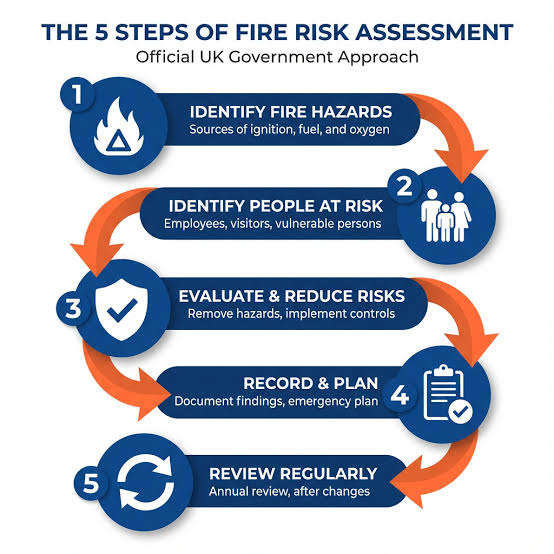
Official guidance and Nottinghamshire Fire and Rescue Service describe a consistent five-step process. The accessible 5-step checklist summarises it as follows:
- Identify the fire hazards — ignition sources, fuel and oxygen. Common in Newark premises: electrical systems, cooking equipment, heating appliances and stored materials in older buildings.
- Identify people at risk — employees, visitors, customers, guests and anyone who may need assistance. Tourism and Showground events mean many people may be unfamiliar with the building.
- Evaluate, remove or reduce the risks — assess means of escape, detection and warning, emergency lighting and management arrangements. Reduce risks so far as reasonably practicable.
- Record your findings, prepare an emergency plan and provide training — a full written record is now required in all cases.
- Review and update the fire risk assessment regularly — after any significant change or if it is no longer valid.
Fire Door Surveys and Inspections: What They Involve and Why They Matter in Newark
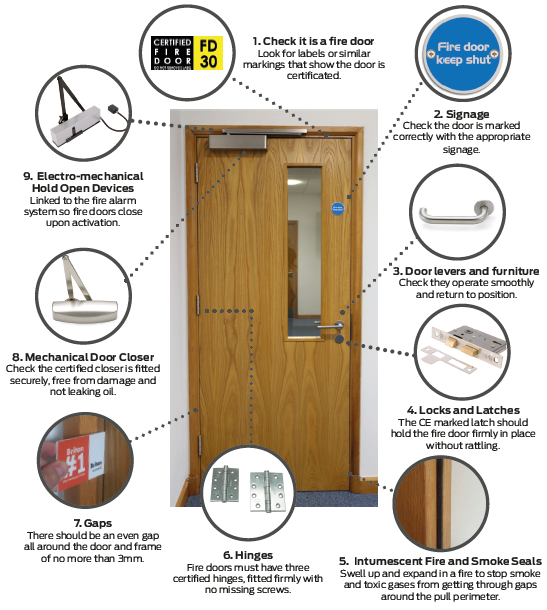
Fire doors are a critical part of passive fire protection and means of escape. A professional fire door survey is a systematic examination of each doorset to determine whether it is likely to perform as intended in a fire. It goes beyond a basic visual check.
A competent surveyor checks the entire assembly against available certification, BS 8214:2026 guidance and the expectations of the fire risk assessment. This includes measuring gaps, assessing intumescent and smoke seals, testing the closer, examining ironmongery, and reviewing the condition of the leaf and frame. Findings are recorded with clear recommendations and photographic evidence.
Routine visual checks by a Responsible Person or caretaker are useful for spotting obvious problems (doors that will not close, damaged seals, or doors wedged open). They are not a substitute for a detailed professional survey, especially in higher-risk or multi-occupied buildings. In Newark’s older commercial and hospitality stock, defects that affect performance are common and often not obvious without measurement and knowledge of certification requirements.
Routine check vs professional fire door survey
| Aspect | Routine Responsible Person check | Professional fire door survey |
|---|---|---|
| Depth | Visual only | Measured gaps, seals, certification review |
| Who carries it out | Caretaker, manager or staff | Competent surveyor |
| Records | Simple log | Detailed report with photos and actions |
| Typical frequency | Monthly or quarterly | 6- or 12-monthly (risk-based) |
| Purpose | Spot obvious problems | Confirm performance and support compliance |
Regulation 10 sets minimum check intervals for certain residential buildings. Professional surveys provide the deeper evidence many Responsible Persons and insurers expect.
Specific Considerations for Newark Premises
Newark’s historic character and visitor patterns create distinctive issues:
- Heritage and Georgian buildings: Traditional construction, complex layouts, limited compartmentation and shared escape routes. Fire doors and protected routes need careful evaluation.
- Tourism and events: Hotels, guest houses, holiday lets and high-street premises experience significant variation in visitor numbers, including during major Showground events. Escape capacity and clear procedures are important when many occupants are unfamiliar with the building.
- Holiday lets and short-term accommodation: Sleeping risk raises the standard required. Detection, means of escape and management arrangements must be robust.
- High-street commercial premises: Shops and cafés in older buildings often have limited escape options.
- Local knowledge: Assessors familiar with market-town layouts and historic stock can schedule efficiently and identify common local issues.
How Often Assessments and Fire Door Checks/Surveys Are Required or Recommended
The Fire Safety Order requires the fire risk assessment to be reviewed regularly and after any significant change. Good practice supports at least an annual review for most commercial premises.
For fire doors, Regulation 10 sets minimum intervals for multi-occupied residential buildings over 11 metres (quarterly communal checks; annual flat entrance checks on a best-endeavours basis). Elsewhere, frequency is determined by the fire risk assessment. Many Responsible Persons arrange professional fire door surveys at least every 6 or 12 months, with more frequent routine checks in high-traffic settings.
Choosing a Competent Assessor and Fire Door Surveyor
Competence is demonstrated through knowledge, experience and (ideally) independent verification. Third-party certification schemes accredited by UKAS provide strong evidence of company processes. Practical competence includes experience with older commercial buildings, tourism premises and historic stock in Nottinghamshire.
Staines Safety Services Ltd provides fire risk assessments and fire door surveys that support businesses and Responsible Persons in Newark and Nottinghamshire, taking account of local building types and occupancy patterns.
What a Good Assessment or Survey Report Should Contain
A useful fire risk assessment report typically includes a description of the premises, people at risk, hazards and risk evaluation, assessment of general fire precautions, significant findings, a prioritised action plan, and outline emergency plan and training requirements.
A good fire door survey report includes door-by-door identification, measured gaps where relevant, seal and closer condition, photographic evidence, prioritised recommendations, and clear reference to standards and legal context. Both reports should help the Responsible Person demonstrate compliance if NFRS inspects.
Common Mistakes Businesses in Newark Make
- Relying on an outdated assessment that does not meet the 2023 full-recording requirements
- Using a generic assessment that ignores heritage or converted building layouts
- Treating routine visual checks as a substitute for professional fire door surveys
- Failing to address Regulation 10 duties in multi-occupied residential buildings over 11 metres
- Not reviewing after refurbishment, change of occupancy or significant events
- Choosing assessors or surveyors without relevant experience of older Nottinghamshire commercial or hospitality premises
- Neglecting common defects such as excessive gaps, damaged seals or non-functioning closers
Fire Risk Assessment and Fire Door Survey FAQs for Newark
Do I need a fire risk assessment for a shop or hotel in Newark?
Yes. Non-domestic premises fall within the scope of the Regulatory Reform (Fire Safety) Order 2005. The Responsible Person must carry out a suitable and sufficient assessment.
Is a full written record required?
Yes. Following Section 156 of the Building Safety Act 2022, the full assessment and fire safety arrangements must be recorded in all cases.
What is the difference between a fire risk assessment and a fire door survey?
The assessment looks at the overall premises and fire precautions. A fire door survey is a detailed examination of individual doorsets to confirm they are likely to perform in a fire.
How often should fire doors be surveyed in Newark?
Frequency is set by the fire risk assessment. Regulation 10 sets minimum check intervals for certain residential buildings. Many premises arrange professional surveys every 6 or 12 months.
Who enforces these requirements in Newark?
Nottinghamshire Fire and Rescue Service.
Do holiday lets need a fire risk assessment?
Yes, in most cases where sleeping accommodation is provided.
Does BS 8214 apply?
Yes. BS 8214:2026 is the recognised code of practice used as a benchmark for fire door specification, installation and performance in use.
Where can I find official guidance?
Start with the Nottinghamshire Fire and Rescue Service fire risk assessment page and the GOV.UK fire doors guidance.
Next Steps for Premises in Newark
If you operate premises in Newark-on-Trent or the surrounding area, confirm that you are the Responsible Person under the Regulatory Reform (Fire Safety) Order 2005. Review any existing assessment against the five-step process and current recording requirements. Identify whether Regulation 10 duties apply and whether professional fire door surveys are needed to support the assessment.
Prioritise premises with sleeping accommodation, high visitor numbers, complex older layouts or multi-occupied residential buildings over 11 metres. Keep clear records of assessments, surveys, routine checks and remedial work.
Staines Safety Services Ltd supports businesses and Responsible Persons across Newark and Nottinghamshire with suitable and sufficient fire risk assessments and competent fire door surveys that take account of local building types and operational realities. Taking these steps protects people, supports compliance and reduces the risk of enforcement in one of Nottinghamshire’s most distinctive market towns.