Forres Fire Risk Assessments
Why Choose a Fire Risk Assessor Who Understands Forres and Scottish Law?
Comprehensive Fire Risk Assessments for All Property Types
- HMO fire risk assessments – Needed for houses in multiple occupation and licensing compliance.
- Business and commercial assessments – Offices, shops, restaurants, pubs, factories and industrial sites.
- Short-term let and holiday accommodation assessments – Supporting hosts applying for or holding a short-term let licence. See SFRS short-term lets guidance.
- Landlord and managing-agent assessments – Rental properties, common stairs and mixed-use buildings.
- Sleeping-risk premises – Hotels, B&Bs, hostels and similar premises covered by Scottish sleeping-accommodation guidance.
- Common areas – Stairs, corridors, plant rooms, bin stores and shared spaces.
No property is too small or too complex. From a single shop on Tolbooth Street to a hotel, care premises or residential block in Forres, we assess the building as it is actually used.
Type 1, Type 2, Type 3 and Type 4 Fire Risk Assessments
- Type 1 – Non-intrusive assessment of common parts only. The usual starting point for most blocks and many HMOs.
- Type 2 – Intrusive inspection of common parts, opening up construction where needed to check compartmentation and fire stopping.
- Type 3 – Non-intrusive assessment of common parts plus a sample of individual dwellings or flats.
- Type 4 – The most thorough option: intrusive inspection of both common parts and a sample of flats.
We recommend the appropriate type based on construction, occupancy, previous findings and risk. For high-rise domestic buildings we also work to the Scottish Government’s practical fire safety guidance for existing high rise domestic buildings.
External Walls, Compartmentation and Flat Entrance Doors
Scottish Government Fire Safety Guides
- Practical fire safety guidance for existing premises with sleeping accommodation
- Practical fire safety guidance for existing high rise domestic buildings
- SFRS business advice and guidance
- Building Standards Technical Handbook – domestic fire / means of escape
- Fire and smoke alarms in Scottish homes (relevant to domestic alarm standards; separate from the workplace/relevant-premises assessment duty)
These guides remain essential references for duty-holders and competent assessors in Forres.
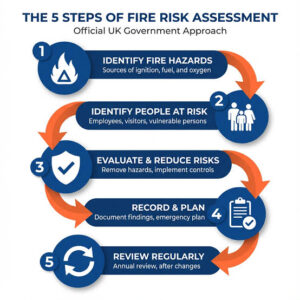
The Five Steps to a Fire Risk Assessment in Scotland
- Identify the people at risk – Employees, residents, guests, visitors, contractors, children, older occupants, people with disabilities and anyone who may be asleep or unfamiliar with the building.
- Identify the fire hazards – Sources of ignition, fuel and oxygen, including cooking, electrical equipment, smoking, arson, housekeeping and dangerous substances.
- Evaluate the risk and decide whether existing measures are adequate – Consider likelihood and consequences, then reduce hazards and put in place detection, warning, escape routes, fire-fighting equipment, compartmentation, emergency plans and training.
- Record the findings – Record significant findings and the people at risk. Recording is required in specified circumstances, including where there are five or more employees.
- Review the assessment – Review it regularly and whenever the building, occupancy, use or fire safety arrangements change, or after an incident. Regulation 3 of the 2006 Regulations requires the assessment to be kept up to date.
Our assessors follow this Scottish methodology, the relevant practical guides and applicable British Standards for every assessment we carry out in Forres.
Key Fire Safety Legislation in Scotland
- Fire (Scotland) Act 2005 – Part 3 is the primary fire safety law for relevant premises. Section 53 requires employers to assess fire risk to employees and take necessary fire safety measures. Section 54 requires anyone with control of relevant premises, to that extent, to assess risk to relevant persons and take reasonable fire safety measures.
- Fire Safety (Scotland) Regulations 2006 – These expand the Act. They cover review of assessments, fire safety arrangements, dangerous substances, means of escape, maintenance of fire safety measures, and certain firefighter-protection measures in common areas of private dwellings.
- Building (Scotland) Regulations – Apply to new building work, conversions and alterations. Design guidance is in the Technical Handbooks.
- Short-term let licensing – Local authorities licence short-term lets. Dutyholders must have an adequate fire risk assessment and can be asked for a fire safety checklist. SFRS does not issue the licence, but fire safety law still applies. See SFRS short-term lets.
SFRS enforces fire safety duties in relevant premises on a risk-based audit programme. Officers may ask for the fire risk assessment, action plans, training records, emergency plans and maintenance records.
Stay Compliant with Expert Support
A suitable and sufficient fire risk assessment identifies who is at risk, evaluates the hazards, and records the fire safety measures needed to keep people safe. Official SFRS and Scottish Government guidance underlines the need for regular review — especially after changes to the building, occupancy or use.
Whether you need a landlord assessment, an HMO assessment, a commercial assessment, a short-term let assessment or a Type 1–4 survey of a residential block in Forres, our qualified assessors are ready to help.
Contact us today for a competitive quote and peace of mind that your premises meet current Scottish fire safety legislation. In doing so, you protect lives, property and compliance with professional fire risk assessments written for Moray duty-holders.
Contact Us
Contact us today for a competitive quote and peace of mind that your premises meet current fire safety legislation. In doing so, you protect lives, property and compliance with professional fire risk assessments from a trusted team.


