Fire Risk Assessments in Marylebone, London: What Responsible Persons Need to Know
If you manage a shop, restaurant, hotel, professional office, medical practice, or any other non-domestic premises in Marylebone, you almost certainly need a suitable and sufficient fire risk assessment. This is a clear legal duty under English fire safety law, not optional advice.
Marylebone, a central London neighbourhood primarily within the City of Westminster, combines upscale retail along Marylebone High Street, the Harley Street medical district, professional offices, hotels, and a rich stock of Georgian and Victorian buildings. These create specific fire safety challenges in a dense, high-footfall urban environment. The London Fire Brigade is the enforcing authority, and premises here must meet the same standards as anywhere else in England.
This guide explains what a fire risk assessment is, who needs one in Marylebone, the correct legal framework, the official five-step process, and practical considerations unique to the area. It is written for business owners, landlords, managing agents, hoteliers, retailers, and practice managers who want to stay compliant and protect people.
What a Fire Risk Assessment Actually Is (and Why a Generic One Is Not Enough)
A fire risk assessment is a structured examination of your premises, the activities carried out there, the people who use them, and the potential for fire to start and cause harm. Its purpose is to identify hazards, evaluate risks to relevant persons, and determine whether existing general fire precautions are adequate.
Official guidance is clear that the assessment must be suitable and sufficient for the specific premises. A generic template or one-size-fits-all report is rarely enough. In Marylebone this matters because of period building construction, mixed-use layouts, basement premises, high visitor numbers, and multi-occupied commercial units.
The process underpins all other fire safety measures. GOV.UK guidance for those with legal duties under the Regulatory Reform (Fire Safety) Order 2005 sets out the core expectations clearly.
Who Needs a Fire Risk Assessment in Marylebone
Under the Regulatory Reform (Fire Safety) Order 2005, the duty falls on the “Responsible Person.” This is typically:
- The employer (where the premises are a workplace)
- The person who has control of the premises
- The owner or landlord in certain cases
- Anyone with contractual control over fire safety arrangements
The Order applies to virtually all non-domestic premises, including shops, offices, hotels, restaurants, medical practices, places of assembly, and the common parts of buildings containing two or more domestic premises. Single private dwellings are generally outside scope, but the moment premises are used for business, the duties apply.
In Marylebone this covers high-street retail and hospitality, Harley Street consulting rooms and clinics, professional offices, hotels, and mixed-use buildings above or beside commercial units. Managing agents and landlords of multi-occupied buildings often share duties and must cooperate.
English Legal Requirements: Regulatory Reform (Fire Safety) Order 2005 and Key Amendments
The principal legislation is the Regulatory Reform (Fire Safety) Order 2005. It places duties on Responsible Persons to:
- Carry out a suitable and sufficient fire risk assessment
- Take general fire precautions to ensure the safety of relevant persons
- Make appropriate fire safety arrangements
- Provide information and training
- Review the assessment regularly
The Fire Safety Act 2021 clarified that the structure, external walls (including anything attached such as balconies), and flat entrance doors fall within the scope of the Order and must be considered in assessments for relevant buildings.
Section 156 of the Building Safety Act 2022, which came into force on 1 October 2023, strengthened recording requirements. Responsible Persons must now record the full fire risk assessment (including all findings) and the fire safety arrangements in all cases, not only where five or more people are employed or the premises are licensed.
Enforcement is carried out by the London Fire Brigade. Non-compliance can lead to enforcement notices, prohibition notices, or prosecution.
Detailed practical guidance is published under Article 50 of the Order. The main collection is available on the GOV.UK fire safety guidance pages for those with legal duties. Premises-specific guides, such as the one for offices and shops, provide benchmarks used by enforcing authorities.
The 5 Steps of a Fire Safety Risk Assessment
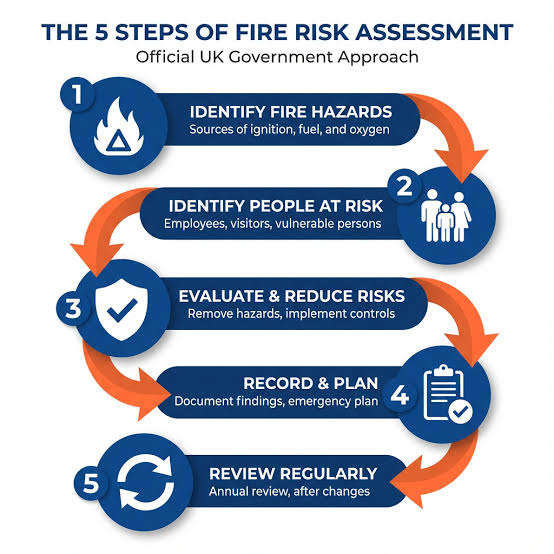
Official Home Office / GOV.UK guidance describes a consistent five-step process. The accessible 5-step checklist summarises it clearly:
- Identify the fire hazards
Consider ignition sources, fuel, and oxygen. In Marylebone premises this commonly includes electrical equipment, cooking facilities, heating systems, stored materials, and (in some cases) lithium batteries from e-bikes or equipment. - Identify people at risk
Assess employees, visitors, customers, patients, contractors, and anyone who may need assistance. High footfall on Marylebone High Street and in hotels means many people may be unfamiliar with the building. - Evaluate, remove or reduce the risks
Judge the likelihood and consequences of fire. Decide whether means of escape, detection and warning, emergency lighting, firefighting equipment, and management arrangements are adequate. Reduce risks so far as reasonably practicable. - Record your findings, prepare an emergency plan and provide training
Since the 2023 changes, a full written record is required in all cases. Prepare an emergency evacuation plan and ensure relevant people receive appropriate information and training. - Review and update the fire risk assessment regularly
Keep the assessment current. Review after any significant change or if you have reason to believe it is no longer valid.
These steps form the foundation of compliance and are the framework used by the London Fire Brigade when auditing premises.
Specific Considerations for Marylebone Premises
Marylebone’s built environment and occupancy patterns create distinctive issues:
- Period and heritage buildings: Many properties are Georgian or Victorian conversions with complex layouts, limited compartmentation, shared escape routes, and basements. Fire door integrity, protected routes, and detection coverage need careful assessment. Alterations may also involve conservation constraints.
- High-footfall retail and hospitality: Marylebone High Street and surrounding streets see significant visitor and tourist numbers. Escape capacity, clear signage, and simple procedures are essential when many occupants are unfamiliar with the premises.
- Harley Street and professional practices: Medical and consulting rooms often have high numbers of patients, some with mobility impairments, plus clinical equipment and, in some cases, flammable materials or medical gases. Personal Emergency Evacuation Plans (PEEPs) and staff training become particularly important.
- Mixed-use and multi-occupied buildings: Cooperation between Responsible Persons is a legal requirement. Commercial units beneath or alongside residential elements require clear coordination of common areas and escape routes.
- Basements and dense urban layouts: Basement premises are common and can present challenges for means of escape, smoke clearance, and access for firefighters.
- Hotels and sleeping accommodation: Higher standards apply where people sleep. Detection, warning, and evacuation strategy must be robust.
The London Fire Brigade regularly attends incidents across Westminster and neighbouring boroughs; local premises should expect risk-based audits focused on higher-risk uses and occupancy types.
How Often the Assessment Must Be Reviewed
The Order requires the assessment to be reviewed regularly so that it remains suitable and sufficient. A review is also required if:
- There is reason to suspect it is no longer valid
- There has been a significant change to the premises, processes, occupancy, or fire safety measures
There is no universal fixed interval, but good practice and the expectations of many enforcing authorities (including guidance referenced by the London Fire Brigade) support at least an annual review for most commercial premises. Any material change—refurbishment, change of use, increase in occupancy, or a fire incident—should trigger an immediate review.
Choosing a Competent Assessor
The Responsible Person must ensure the assessment is suitable and sufficient. Where they lack the necessary competence, they should appoint a competent person to assist. Competence is demonstrated through knowledge, experience, and (ideally) independent verification.
Third-party certification schemes accredited by UKAS, such as BAFE SP205 for life-safety fire risk assessments, provide strong evidence of company processes and assessor competence. Professional registers (for example those maintained by the Institution of Fire Engineers or Institute of Fire Safety Managers) offer another recognised route. The framework in BS 8674:2025 further supports structured competence levels.
In Marylebone, practical competence also includes experience with period commercial buildings, mixed-use properties, high-occupancy retail or hospitality, and healthcare or consulting environments. Ask for evidence of relevant qualifications, insurance, and examples of similar premises.


What a Good Assessment Report Should Contain
A useful report typically includes:
- Description of the premises, use, and occupancy
- Identification of people at risk
- Fire hazards identified and risk evaluation
- Assessment of existing general fire precautions (means of escape, detection and warning, emergency lighting, firefighting equipment, signage, management arrangements)
- Significant findings and a prioritised action plan with realistic timescales
- Outline of the emergency plan and training requirements
- Review date and arrangements
Clear, actionable recommendations that the Responsible Person can implement and evidence are more valuable than lengthy generic text. The report should enable the Responsible Person to demonstrate compliance if the London Fire Brigade inspects.
Common Mistakes Businesses in Marylebone Make
- Relying on an outdated assessment prepared before the 2023 recording changes
- Using a generic assessment that ignores the specific layout of a period or converted building
- Failing to record the full findings and fire safety arrangements (now mandatory)
- Not reviewing after refurbishment, change of occupancy, or other significant changes
- Poor cooperation between Responsible Persons in multi-occupied buildings
- Inadequate consideration of high visitor numbers or people who need assistance to evacuate
- Choosing an assessor without relevant experience of central London commercial or mixed-use premises
- Neglecting basement means of escape or the contribution of external walls and flat entrance doors where relevant
Avoiding these issues reduces the risk of enforcement action and improves actual safety.
Fire Risk Assessment FAQs for Marylebone
Do I need a fire risk assessment for a shop or office in Marylebone?
Yes. Non-domestic premises such as shops and offices fall within the scope of the Regulatory Reform (Fire Safety) Order 2005. The Responsible Person must carry out a suitable and sufficient assessment.
Is a full written record required even for small premises?
Yes. Following the changes introduced by Section 156 of the Building Safety Act 2022 (in force from 1 October 2023), the full assessment and fire safety arrangements must be recorded in all cases.
How often should I review the assessment?
Regularly, and after any significant change. Many Responsible Persons review annually as good practice. The Order requires the assessment to remain suitable and sufficient.
Who enforces fire risk assessments in Marylebone?
The London Fire Brigade.
Can I do the assessment myself?
Yes, if you are competent to do so. For more complex premises (period buildings, sleeping accommodation, high public access, or healthcare use), most Responsible Persons engage a competent third-party assessor.
What happens if I do not have a suitable assessment?
The London Fire Brigade can issue enforcement or prohibition notices. Serious breaches can lead to prosecution.
Does the assessment need to consider external walls and flat entrance doors?
Yes, where relevant. The Fire Safety Act 2021 clarified that the structure, external walls (including attachments), and flat entrance doors must be taken into account.
Are there special considerations for Harley Street practices?
The same law applies, but assessments must account for patient occupancy (including people with reduced mobility), clinical activities, and the need for appropriate evacuation planning and staff training.
Next Steps for Premises in Marylebone
If you operate premises in Marylebone, confirm that you are the Responsible Person (or identify who is) under the Regulatory Reform (Fire Safety) Order 2005. Review any existing assessment against the five-step process and current GOV.UK guidance, paying particular attention to the full recording requirements introduced in 2023.
If the assessment is outdated, incomplete, or does not reflect the specific characteristics of your building and occupancy, arrange a new one carried out by a competent person with relevant experience. Prioritise premises with sleeping accommodation, high visitor numbers, complex period layouts, or vulnerable occupants.
Keep clear records of the assessment, reviews, training, maintenance, and any cooperation arrangements with other Responsible Persons. These records are essential if the London Fire Brigade visits.
Taking these steps protects people, supports compliance, and reduces the risk of enforcement in one of London’s busiest and most varied commercial districts.