Fire Door Inspections for Housing Associations and Managing Agents
Newcastle, Gateshead, Sunderland, Middlesbrough, Durham, Nottingham, Derby, Leicester and Northampton.
Housing associations and managing agents are now expected to prove that fire doors work — not just that they exist. Regular fire door inspections for housing associations are an essential part of meeting these new requirements.
In England, that duty is specific, repeating and documented.If you manage blocks over 11 metres, Regulation 10 of the Fire Safety (England) Regulations 2022 requires the responsible person to:
- check communal fire doors at least every 3 months
- use best endeavours to check flat entrance doors at least every 12 months
- confirm that self-closing devices work
- keep records that stand up to a fire risk assessment, insurer review or regulator request
The government’s fire door guidance explains how those checks apply in multi-occupied residential buildings with two or more dwellings where the top storey is more than 11 metres above ground level — typically four storeys and above. Higher-risk buildings of 18 metres or seven storeys and above also sit under the Building Safety Act 2022 and the higher-risk building regime.Staines Safety Services provides programmed fire door inspections for housing associations, local-authority housing teams, managing agents, RTM companies and RMCs across the North East and East Midlands.


Why this work keeps coming back
This is not a one-off survey. Communal doors need a quarterly cycle. Flat entrance doors need an annual access programme. Missed appointments, refused access and incomplete reports create the exact gaps that enforcement and insurers look for.
The duty sits on the responsible person under the Fire Safety Order. That is usually the landlord, housing association or managing agent with control of the common parts. The Fire Safety Act 2021 also made clear that flat entrance doors form part of the fire risk assessment, not an optional extra.
National evidence still shows the gap is real. The Fire Protection Association’s summary of social-housing fire door research reported that only around 46% of flat entrance doors had been inspected even once since January 2023, with high failure rates and a large repair backlog. Housing associations sit outside much of that public data — which means the responsibility, and the paperwork, stays with you.A checklist visit that says “door present” is not enough. Agents and associations need:
- a door-by-door record
- photographs
- defects ranked by risk
- evidence of access attempts on flats
- a clear list of what must be repaired, replaced or re-inspected
Areas Staines Safety Services covers
We work from offices in the North East, Leeds and London, and we run block programmes in the towns where housing associations and managing agents need a reliable inspection calendar.
North East
Newcastle upon Tyne, Gateshead, Sunderland, Middlesbrough and Durham — including post-war blocks, riverside and quayside developments, student residences and local-authority or housing-association estates.
East Midlands
Nottingham, Derby, Leicester and Northampton — including city-centre blocks, estate stock, converted buildings and mixed portfolios managed for several landlords from one office.If you manage a regional portfolio that also takes in nearby towns, Staines Safety Services can inspect those blocks on the same programme rather than treating each site as a one-off job.
Who the service is for
- Housing association building safety, fire safety and compliance teams
- Local-authority housing compliance and asset teams
- Managing agents responsible for blocks over 11 metres
- RTM and RMC directors who need defensible records
- Facilities and property managers handling student halls, sheltered housing or mixed residential portfolios
We work to your access arrangements, resident letters and existing fire risk assessment, not against them.
What we inspect
Each programmed inspection covers the points that decide whether a fire door will do its job, in line with Regulation 10and industry practice under BS 8214:
- door leaf, frame and condition
- gaps, alignment and distortion
- intumescent strips and smoke seals
- hinges, closer, latch and other ironmongery
- glazing, beads and vision panels where fitted
- signage and keep-shut notices
- labels and identification
- self-closing action
- unauthorised alterations such as cat flaps, poorly fitted letterplates or damaged faces
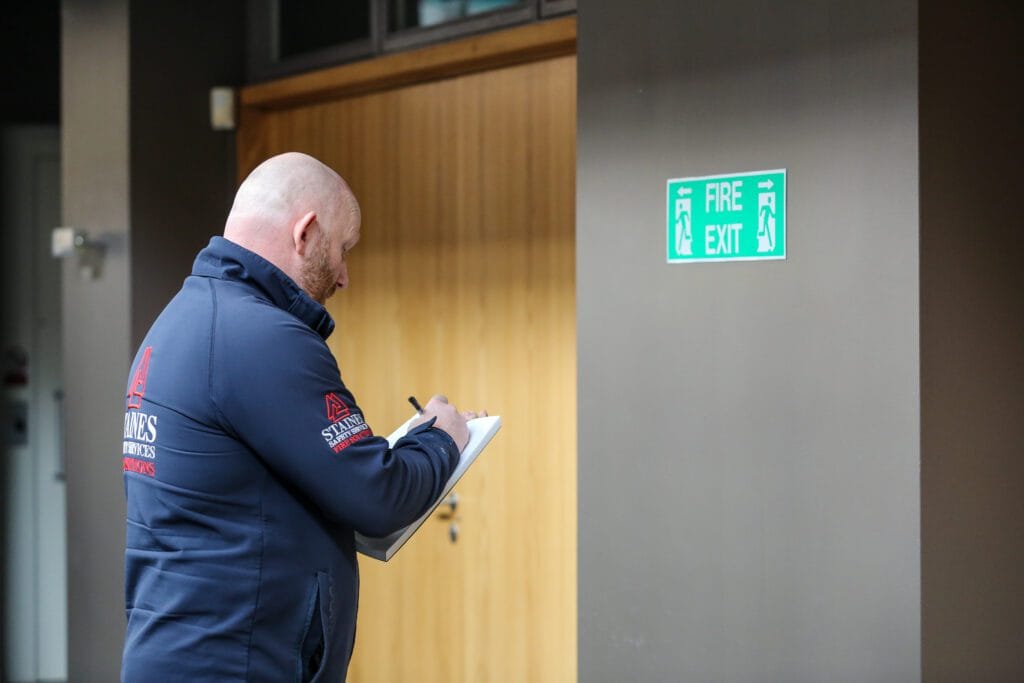
Communal doors are inspected on a quarterly cycle. Flat entrance doors are inspected annually on a best-endeavours basis, with documented access attempts where a resident cannot be reached. New residents must also be given the required fire door information: keep the door shut, do not tamper with the closer, and report damage.
Where the block is a new or refurbished higher-risk building, door records should also sit with the wider building-safety file expected under the Building Safety Regulator regime. Design and specification issues are still judged against Approved Document B.
What you receive from Staines Safety Services
You do not just get a site visit. You get a working compliance file.
- inspection report suitable for the Responsible Person
- photographic evidence for each door
- pass / fail / observe findings
- priority defect list for repairs and replacements
- schedule for the next quarterly and annual visits
- records you can attach to the fire risk assessment and, where relevant, the golden-thread / building-safety file
Also check an inspector’s FDIS certification on the official Fire Door Inspection Scheme register. FDIS is the UKAS-accredited competent-person scheme for fire door inspectors, owned by the British Woodworking Federation.
If you also need remediation, Staines Safety Services can inspect and then programme repairs so failed doors do not sit on a list for months.
How a typical programme works
- You send the block list, storey heights and any existing FRA or previous door reports.
- We confirm which buildings fall under the 11-metre Regulation 10 duties and which still need good-practice inspections.
- We agree access letters, notice periods and a communal / flat split.
- We inspect to a fixed calendar — quarterly communal, annual flats.
- You receive the report and defect schedule.
- Failed doors are booked for repair or replacement, then rechecked.
That is the difference between “we had someone look at the doors” and a programme a compliance manager can defend.Why housing associations and agents use Staines Safety ServicesInternal caretakers and general contractors can spot a broken closer. They are rarely the right people to certify the whole doorset against current expectations.
A specialist inspection from Staines Safety Services gives you:
- consistency across every block in the portfolio
- reports written for auditors, insurers and the fire and rescue service
- a contractor who already understands Regulation 10, BS 8214 and resident-access limits
- fewer last-minute scrambles before an FRA review or regulatory visit
The cost of an organised programme is almost always lower than the cost of an enforcement notice, a failed audit, or a block-by-block emergency tender.
Request inspections for your blocks
If you manage housing stock in Newcastle, Gateshead, Sunderland, Middlesbrough, Durham, Nottingham, Derby, Leicester or Northampton, send Staines Safety Services:
- the number of blocks
- approximate door counts (communal and flat entrance)
- whether you need inspection only, or inspection plus repair
- your current inspection dates or FRA review date
We will return a programme price and a proposed first-visit date.
Staines Safety Services
- Fire door inspections for housing associations and managing agents Phone: 07885 982771
- Office: 01287 659429 (tel:01287659429)
- Email: info@stainessafetyservices.co.uk
- Web: stainessafetyservices.co.uk
- North East office: Skelton-in-Cleveland, Saltburn-by-the-Sea
- Also working from Leeds and London for regional portfolios