Yarm and Stockton Fire Risk Assessments
Looking for a reliable fire risk assessment in Yarm or fire risk assessment in Stockton? Whether you manage an HMO, run a business, rent out an AirBnB, or oversee common areas in a residential block, a thorough fire risk assessment is a legal requirement under the Regulatory Reform (Fire Safety) Order 2005.
At our Middlesbrough-based firm, we specialise in high-quality, compliant fire risk assessments across Yarm, Stockton-on-Tees, and the wider Teesside area. Our local fire risk assessors deliver Type 1, Type 2, Type 3, and Type 4 assessments for every type of building. In addition, we carry out specialised Fire Risk Appraisals of External Walls (FRAEW). We hold ISO 9001 and ISO 18001 certifications. We are also proud members of the Institute of Fire Safety Managers (IFSM) and the National Association of Fire Door Inspectors (NAFDI).
Why Choose a Local Fire Risk Assessor for Yarm and Stockton?
Our entire team of fire risk assessors is based in Middlesbrough and works extensively across Yarm and Stockton. Every assessor holds a minimum Level 4 Diploma in Fire Risk Assessment, ensuring competence for all but the most complex buildings in line with current UK standards and guidance. This local knowledge means faster response times. Additionally, it brings deeper understanding of regional property types (from historic market-town buildings and residential properties in Yarm to commercial units, mixed-use developments and housing stock across Stockton). It ensures practical recommendations tailored to Cleveland Fire Authority expectations.
We maintain ISO 9001 for quality management systems and ISO 18001 (OHSAS 18001) for occupational health and safety management. These accreditations demonstrate our commitment to consistent, high-standard service delivery and safe working practices. As members of the IFSM and NAFDI, we stay at the forefront of best practice in fire safety management and fire door standards.
Comprehensive Fire Risk Assessments for All Property Types
We provide fire risk assessments for all types of buildings and properties, including:
- HMO fire risk assessments – Essential for houses in multiple occupation to meet licensing and safety rules.
- Business premises and commercial fire risk assessments – Offices, shops, restaurants, factories, and industrial sites.
- AirBnB and short-term let fire risk assessments – Protecting guests and meeting host responsibilities.
- Landlord fire risk assessments – Covering rental properties and ensuring compliance for freeholders and managing agents.
- Risk assessments for common areas – Corridors, stairwells, plant rooms, and shared spaces in blocks of flats or mixed-use buildings.
No property is too small or complex. From residential blocks and community properties in Yarm to mixed-use and commercial buildings across Stockton, we assess every type of building.
Type 1, Type 2, Type 3 and Type 4 Fire Risk Assessments Explained
We offer the full range of fire risk assessment types commonly used for housing and residential premises (aligned with guidance such as BS 9792 and previous PAS 79 standards):
- Type 1 – Non-intrusive assessment of common parts only. The standard starting point for most blocks of flats and HMOs.
- Type 2 – Intrusive inspection of common parts (opening up construction where needed to check compartmentation and fire stopping).
- Type 3 – Non-intrusive assessment of common parts plus a sample of individual dwellings/flats.
- Type 4 – The most thorough option: intrusive inspection of both common parts and a sample of flats.
Our assessors recommend the appropriate type based on building risk, construction, occupancy, and previous findings. We always follow a structured, risk-proportionate methodology.
Fire Risk Assessment of External Walls (FRAEW)
Following the Fire Safety Act 2021, fire risk assessments for multi-occupied residential buildings must consider external walls. Where combustible materials, cladding, or construction details raise concerns, we provide a full Fire Risk Appraisal of External Walls (FRAEW) in accordance with PAS 9980:2022.
An FRAEW evaluates the risk of external fire spread and informs your overall fire risk assessment. It helps determine whether remediation or mitigation measures are needed. Our team delivers clear, proportionate reports that support responsible persons in meeting their duties in Yarm and Stockton.
CLG Fire Safety Guides
The government (originally published by Communities and Local Government – CLG, and now maintained under the Home Office / Ministry of Housing, Communities and Local Government) has issued a comprehensive series of official fire safety risk assessment guides. These support responsible persons in complying with the Regulatory Reform (Fire Safety) Order 2005 and carrying out suitable and sufficient assessments. Key guides include:
- Fire safety risk assessment: offices and shops
- Fire safety risk assessment: factories and warehouses
- Fire safety risk assessment: sleeping accommodation
- Fire safety risk assessment: residential care premises
- Fire safety risk assessment: educational premises
- Fire safety risk assessment: healthcare premises
- Fire safety risk assessment: theatres, cinemas and similar premises
- Fire safety risk assessment: large places of assembly
- Fire safety risk assessment: small and medium places of assembly
- Fire safety risk assessment: open-air events and venues
- Fire safety risk assessment: means of escape for disabled people
- Additional practical guides for smaller premises, such as Making your small non-domestic premises safe from fire, Making your small paying guest accommodation safe from fire, and Fire safety in purpose-built blocks of flats.
These guides remain essential references for responsible persons and competent assessors.
The Five Steps to Fire Risk Assessment
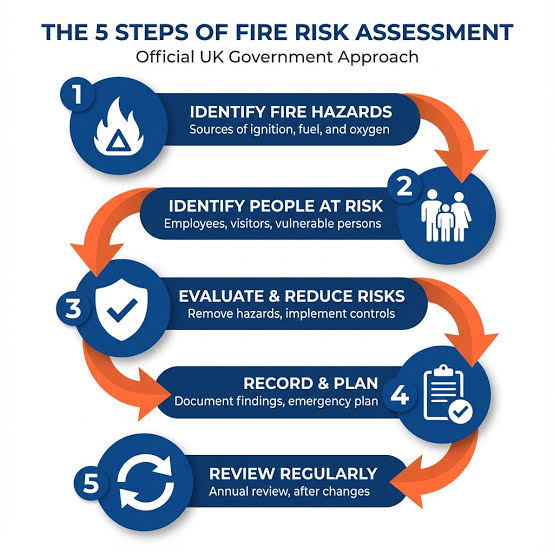
Official government guidance sets out a clear five-step process for carrying out a suitable and sufficient fire risk assessment (see the Fire safety risk assessment: 5-step checklist):
- Identify the fire hazards – Look for sources of ignition, fuel and oxygen (for example, electrical equipment, cooking appliances, flammable materials, arson risks and poor housekeeping).
- Identify people at risk – Consider who could be harmed, including employees, residents, visitors, guests, contractors, people with disabilities, children, older occupants or anyone who may be particularly vulnerable.
- Evaluate, remove or reduce the risks – Assess the likelihood and potential consequences of fire, then take action to eliminate or reduce hazards and put in place appropriate fire precautions (detection, warning, escape routes, fire-fighting equipment, compartmentation, etc.).
- Record your findings, prepare an emergency plan and provide training – Document the significant findings, the people at risk and the measures in place. Create a clear emergency plan and ensure staff and relevant persons are trained and informed.
- Review and update the fire risk assessment regularly – Revisit the assessment periodically and whenever there are significant changes to the building, occupancy, use or after an incident, to ensure it remains suitable and sufficient.
Our assessors follow this structured methodology (and relevant British Standards) for every assessment we carry out in Yarm and Stockton.
Key Fire Safety Legislation
- Regulatory Reform (Fire Safety) Order 2005 (RRFSO) – The primary legislation requiring a suitable and sufficient fire risk assessment for virtually all non-domestic premises and the common parts of multi-occupied residential buildings. It places duties on the “responsible person” to identify fire hazards, evaluate risks, and put in place general fire precautions. Full text: https://www.legislation.gov.uk/uksi/2005/1541/contents.
- Fire Safety Act 2021 – Clarifies that, in buildings containing two or more sets of domestic premises, the RRFSO applies to the building’s structure, external walls (including cladding, balconies and attachments), and all doors between domestic premises and the common parts. Full text: https://www.legislation.gov.uk/ukpga/2021/24.
- Fire Safety (England) Regulations 2022 – Introduce additional specific duties for responsible persons of multi-occupied residential buildings (including information sharing with the fire and rescue service, fire door checks, wayfinding signage, secure information boxes and resident information). They apply in England and came into force on 23 January 2023. Full text: https://www.legislation.gov.uk/uksi/2022/547/contents.
Stay Compliant with Expert Support
A suitable and sufficient fire risk assessment identifies hazards, evaluates who is at risk, and records the precautions needed to keep people safe. Official guidance, including the Government’s five-step checklist, underlines the importance of regular review—especially after changes to the building, occupancy, or use.
Whether you need a landlord fire risk assessment, an HMO assessment, commercial coverage, or an FRAEW in Yarm or Stockton, our qualified local assessors are ready to help.Contact us today for a competitive quote and peace of mind that your premises meet current fire safety legislation. In doing so, you protect lives, property, and compliance with professional fire risk assessments from a trusted Teesside team.
Contact Us
Contact us today for a competitive quote and peace of mind that your premises meet current fire safety legislation. In doing so, you protect lives, property, and compliance with professional fire risk assessments from a trusted Teesside team.