
Do You Need a Fire Risk Assessment?
Yes – in most cases, you legally need a fire risk assessment if you control non-domestic premises or the communal areas of multi-occupied residential buildings in England and Wales.Under the Regulatory Reform (Fire Safety) Order 2005 (the Fire Safety Order), the “Responsible Person” must carry out a suitable and sufficient fire risk assessment. This duty applies to virtually all workplaces, commercial buildings, and the common parts of blocks of flats, HMOs, and similar properties.
Single private dwellings occupied by one household are generally exempt. Failing to have one when required is a criminal offence that can lead to unlimited fines, prohibition notices, or even imprisonment.
What Is a Fire Risk Assessment?
A fire risk assessment is a systematic evaluation of your premises to identify fire hazards, the people at risk, and the measures needed to prevent fire and ensure safe escape. It forms the foundation of your fire safety management and must be kept under review.
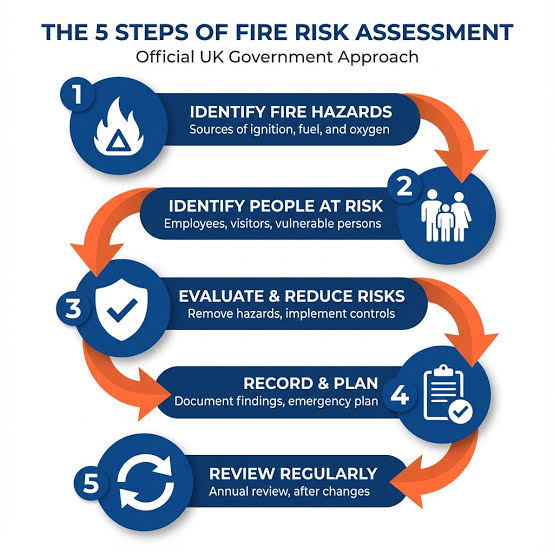
The process follows the official five-step approach recommended by the UK government:
- Identify fire hazards (ignition sources, fuel, oxygen).
- Identify people at risk (employees, visitors, vulnerable individuals).
- Evaluate, remove or reduce the risks and protect people.
- Record findings, prepare an emergency plan, inform and train.
- Review the assessment regularly.
Is a Fire Risk Assessment a Legal Requirement in the UK?
Yes. The Fire Safety Order makes it a strict legal duty for the Responsible Person in almost all non-domestic premises in England and Wales. Equivalent legislation exists in Scotland (Fire (Scotland) Act 2005) and Northern Ireland.Key points:
- It applies regardless of the number of employees.
- Since 1 October 2023 (Section 156 of the Building Safety Act 2022), every fire risk assessment must be recorded in full — the previous exemption for fewer than five employees no longer exists.
- You must also record your fire safety arrangements and the identity of anyone who helped complete or review the assessment.
Who Needs a Fire Risk Assessment?
You almost certainly need one if you are responsible for any of the following:
- Offices, shops, restaurants, pubs, cafés and retail premises
- Factories, warehouses and industrial units
- Hotels, hostels, B&Bs and other sleeping accommodation
- Schools, colleges, hospitals, care homes and GP surgeries
- Places of worship, village halls, community centres and leisure facilities
- The communal areas of blocks of flats (stairwells, hallways, bin stores, etc.)
- Houses in Multiple Occupation (HMOs)
- Any premises open to the public or where people work
Landlords of properties with shared areas and managing agents also have duties.
Who Is the Responsible Person?
The Responsible Person is usually:
- The employer
- The building owner or freeholder
- The landlord
- The occupier or person in control of the premises
In multi-occupied buildings, duties can be shared. Clear agreements help avoid gaps.
When Do You Not Need a Fire Risk Assessment?
The Fire Safety Order does not apply to:
- Single private dwellings occupied by one household
- Certain specialised sites (offshore installations, ships under the master’s control, mines, aircraft, etc.)
Even if the Order does not apply, other legislation (such as the Housing Act 2004 and HHSRS for rented homes) may still require fire safety measures.If in doubt, arrange an assessment. It is far safer (and cheaper) than facing enforcement action.
What Happens If You Don’t Have a Fire Risk Assessment?
Local fire and rescue services enforce the law. Consequences can include:
- Enforcement or prohibition notices
- Unlimited fines
- Up to two years’ imprisonment for serious breaches
- Closure of the premises
- For landlords: impact on licences or rent repayment orders
Can I Carry Out My Own Fire Risk Assessment?
Yes — the law allows the Responsible Person to do it themselves if they are competent. Competence means having enough knowledge, training and experience for the specific premises.
For simple, low-risk premises (a small one-room office or single-let shop), a competent person using the official government guides may be sufficient. For anything more complex — HMOs, blocks of flats, care homes, restaurants, multi-storey buildings or premises with vulnerable people — a professional, competent fire risk assessor is strongly recommended.
Look for credentials such as BAFE SP205 or IFE membership.
How Often Should a Fire Risk Assessment Be Reviewed?
There is no fixed legal interval, but the assessment must be reviewed:
- Regularly (best practice is at least annually)
- Whenever there is reason to believe it is no longer valid
- After significant changes (layout alterations, new occupancy, changes in use, new equipment, or after a fire or near-miss)
Recent Changes You Must Know About (2023 Onwards)
- Full written recording of the entire assessment is now mandatory for everyone.
- The Fire Safety Act 2021 confirmed that external walls, flat entrance doors and structure must be considered.
- Additional duties apply under the Fire Safety (England) Regulations 2022 for certain residential buildings (e.g. fire door checks, information for residents).
Frequently Asked Questions
Do small businesses need a fire risk assessment?
Yes. Size no longer matters — every non-domestic premises requires one, and it must be written down.Do I need a fire risk assessment for a block of flats?
Yes — for the communal areas. Individual self-contained flats are usually outside the Order, but the common parts are not.Is a fire risk assessment the same as a fire certificate?
No. Fire certificates were abolished in 2006. You need a current fire risk assessment instead.How much does a professional fire risk assessment cost?
Prices vary by size and complexity, but professional assessments typically start from a few hundred pounds for small premises.
Where can I find official guidance?
The government publishes free fire safety risk assessment guides for different premises types and a simple 5-step checklist on GOV.UK.
Conclusion: Don’t Wait – Check Your Compliance Today
If you control non-domestic premises or communal residential areas, a suitable and sufficient fire risk assessment is not optional — it is a legal requirement designed to save lives. Review yours now, ensure it is fully recorded, and keep it up to date.
Need help determining whether your premises require one or arranging a competent assessment?
Speak to a qualified fire safety professional or consult the official GOV.UK guidance for your premises type.Staying compliant protects people, your business, and your reputation.